REVIEW · BEIJING
Beijing Lama Temple Entrance Ticket with Optional Guided Service
Book on Viator →Operated by Unique Beijing Tours · Bookable on Viator
Beijing’s Lama Temple is history you can smell. This Yonghegong visit pairs prepaid admission with an optional English-speaking guide, which helps you read the buildings, prayers, and religious details fast. I like that the site isn’t just a museum now—it’s still a functioning Tibetan Buddhist temple where people come to pray.
What I really appreciate is the focus on practical access: you get the entrance ticket included, and you can choose a group setup that keeps the day moving without feeling chaotic. I also like the chance to learn specific temple subtleties in clear English, including how major halls are used and why certain statues and objects matter.
One consideration: your entry depends on the ticket QR/barcode working correctly. A few past issues reported by customers suggest you should keep your QR ready offline and be prepared to contact the provider if something doesn’t scan.
In This Review
- Key things to know before you go
- Yonghegong: A palace reborn as Tibetan Buddhism
- Price and logistics: why $7 can be good value
- Guided service: what you’ll learn in English
- Entering Yonghegong: how the day usually feels
- Inside the complex: what to focus on once you’re through the gates
- Crowds, time limits, and how to avoid the most common frustrations
- Pairing Yonghegong with nearby Beijing highlights
- Who this is best for (and who might skip the guide)
- Ticket reliability tips (learn from the hard cases)
- Should you book this Lama Temple ticket service?
- FAQ
- How much is the Beijing Lama Temple entrance ticket?
- Is the entrance ticket included?
- Do I need to book a guided tour, or is it optional?
- When will I receive my tickets?
- Is this a private tour?
- Where is the Lama Temple located in Beijing?
- Is the site easy to reach with public transport?
- What is the cancellation policy?
- What if my QR code doesn’t work at the entrance?
Key things to know before you go
- Prepaid ticket timing: tickets are sent about 5 days before your travel date.
- Optional guided service: choose an English-speaking guide to unpack the site’s Tibetan Buddhist meaning.
- Private group setup: it’s only your group, not a mixed crowd tour.
- Temple + prayers, not just sightseeing: the complex is a working religious site.
- Plan for real-world crowds: queues can happen, even if they may move quickly.
- Incense ritual tip: once you’re in, pick up any offered incense sticks to join the ritual.
Yonghegong: A palace reborn as Tibetan Buddhism
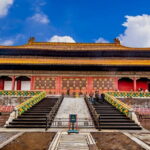
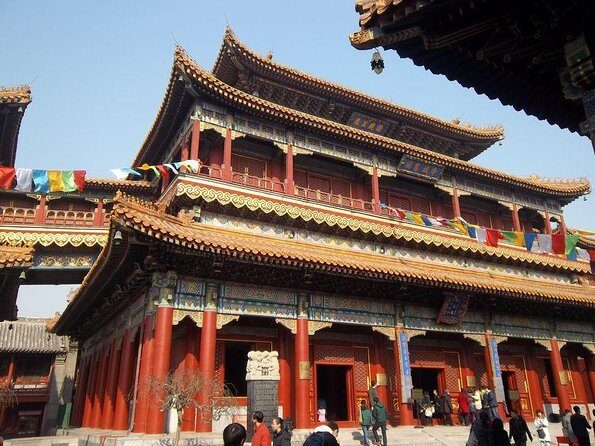
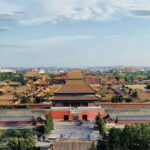
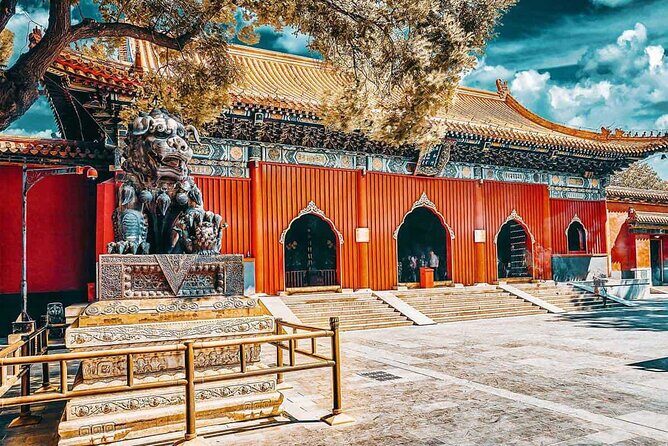
Yonghegong, commonly called the Lama Temple, is one of Beijing’s most important Tibetan Buddhist sites. What makes it special is the background story: in the Qing Dynasty, the emperor Qianlong converted a royal palace into a Tibetan Buddhist temple. That mix of imperial architecture and religious purpose is the big “aha” here. You’re not only looking at art—you’re walking through a space that was repurposed for worship and religious teaching.
You can also feel the difference between “tourist landmark” and “active temple.” People pray. Incense is part of the atmosphere. If you like cultural travel that respects living traditions, this is a strong match.
And yes, it’s huge. The Lama Temple is described as one of the largest and most important Tibetan Buddhist temples in the world, and when you’re inside you quickly understand why people spend real time here instead of just taking a few photos and leaving.
You can also read our reviews of more tours and experiences in Beijing
Price and logistics: why $7 can be good value
At $7.00 per person, the headline value is the fact that entrance is included. For many travelers, that’s the difference between a smooth start and a scramble—especially if your day already includes other stops.
This service also offers group discounts, and it’s run as a private experience for your group only. That matters in practice because Yonghegong can get crowded. When you’re not sharing space with strangers from multiple tours, it’s easier to move as a unit and keep your bearings.
How this works for your planning:
- You’ll receive your ticket ahead of time (about 5 days before).
- You go to the Lama Temple, show the QR for entry, and you’re in.
- If you select the optional guided service, the guide helps you focus on what you’re seeing so you don’t wander through 100 details with no context.
The main logistics “risk” isn’t the temple itself. It’s ticket scanning. Some customers reported problems when QR codes weren’t accepted or didn’t scan properly, which led to needing to purchase again on-site. That doesn’t mean the service is consistently broken, but it does mean you should take two minutes now to prepare:
1) save the QR code email and a screenshot on your phone, and
2) be ready to use the provided contact support if scanning fails.
Guided service: what you’ll learn in English
If you choose the guided option, you’re paying for something that’s hard to get on your own: structured context. The Lama Temple includes Tibetan Buddhist symbolism that can be tough to decode just by looking at it.
The guides praised in customer feedback include people like Mina, Mike, Kevin, and Jack—all noted for clear English explanations. While each guide’s style varies, the strong theme is that you’ll understand:
- how the buildings are used,
- what religious details mean,
- and why certain objects or statues have specific significance.
One example that comes up in feedback: the temple’s large Buddha statue representations, including a very tall Maitreya statue (around 18 meters). Without context, it’s still impressive. With context, it becomes easier to understand why people pay attention to it and how it fits into the temple’s overall religious story.
Even if you don’t choose a guide, you can still get value from the way the temple is laid out. But a guide helps you spend less time asking what you’re looking at and more time appreciating what it represents.
Entering Yonghegong: how the day usually feels
The experience starts with the practical part: getting in smoothly. Yonghegong is near public transportation, so you shouldn’t need a complicated route plan. Once you enter, expect to move through portals and courtyards. The flow is designed to handle crowds, but you’ll still want to keep your pace steady.
Here’s where having a prepaid ticket really helps. On busy days, lines to buy entry can eat time you’d rather spend inside. Prepaid tickets can reduce that friction—especially if you plan to arrive at a reasonable hour.
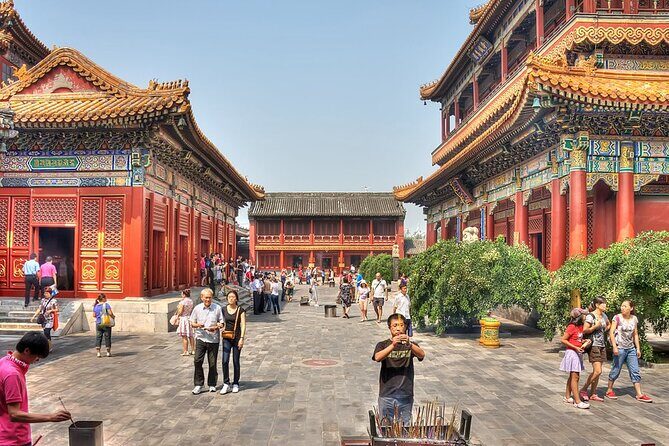
Inside, the vibe changes quickly from “I’m here” to “I’m in a working sacred space.” Incense makes it feel grounded and real. If you’re sensitive to strong smells, it’s worth knowing that incense is part of the ritual culture of the complex.
Inside the complex: what to focus on once you’re through the gates
Because Yonghegong is both a temple and a school of Tibetan Buddhism, it’s not built like a single museum hall. It’s a sequence of spaces, each with its own role.
Here’s how I’d prioritize your time so you don’t feel rushed:
- Look for ritual cues. People moving together, facing certain directions, and performing actions give you a “map” even if you don’t speak the religious language.
- Spend time at major halls before chasing smaller corners. The big rooms are where the symbolism is most concentrated.
- Use any guide time (if you booked it) to connect the dots. The best guides help you understand the point of each hall, not just the dates.
A highlight that often draws attention is the way the final areas create a strong visual and spiritual focus—especially with large statues and ritual spaces. That’s where context helps most, since size alone doesn’t always tell you what the object is meant to represent.
Also, don’t ignore the human details. Incense rituals are a key part of the experience. One practical tip from feedback: once you pass the portals, you may be offered incense sticks. If you want to participate, pick them up while they’re available. It’s one of those “simple but memorable” actions that makes the visit feel like you actually joined the moment, not just watched it.
You can also read our reviews of more guided tours in Beijing

Crowds, time limits, and how to avoid the most common frustrations
Yonghegong can be busy. That’s not a guess; it’s a reality you should plan for. The good news: several notes point out that queues, when they happen, can move quickly.
Still, you should expect some waiting and plan your route accordingly. If your day is packed with other Beijing sights, build in buffer time so you’re not stressed if entry lines take longer than expected.
A separate timing issue that showed up in feedback: the temple visit time can feel shorter if it closes earlier than you expected. So I’d do this:
- check the temple’s hours the day of your visit, and
- don’t schedule a hard “must-see” right after with no cushion.
If you’re booking the guided option, this matters even more. A guide is there to help you understand what you see, so you want to have enough time to hear the explanations rather than rushing through because the site is closing.
Pairing Yonghegong with nearby Beijing highlights
One perk: Yonghegong sits in an area where you can add other worthwhile stops. Feedback notes that it’s close to the Confucius Temple and also near popular Chengxian Street. That gives you an easy “cultural + street life” plan.
If you like walking, this is the kind of location where you can shape your own route:
- Visit Yonghegong first (it’s the anchor).
- Then keep moving through nearby cultural sites.
- Finish with a snack and a stroll on Chengxian Street to reset your energy.
This is especially useful if you’re traveling with people who want both meaningful sights and a chance to wander.
Who this is best for (and who might skip the guide)
This experience is designed for most travelers, with a simple structure: one main stop at Lama Temple (Yonghegong). That makes it a good match if:
- you want a major Beijing religious landmark without over-planning,
- you appreciate guidance that explains meaning, not just facts,
- or you’re traveling with family and want a private-group day feel.
I’d also say the optional guide is a smart choice if you’re the type who enjoys understanding “why” and “how,” not just “what it looks like.” When the guide is good (and feedback names several strong ones like Mina, Mike, Kevin, and Jack), the complex stops feeling random.
You might skip the guide if:
- you prefer independent pacing,
- you already know a lot about Tibetan Buddhism,
- or you mainly want the atmosphere and photos and don’t need help interpreting symbolism.
Ticket reliability tips (learn from the hard cases)
Most people get in smoothly with a valid QR ticket. But the negative feedback you should take seriously is this: some people arrived with QR that didn’t work and had to buy again on-site, which cost them extra.
To protect yourself, treat ticket prep like part of the tour:
- Keep the QR code email you receive around your ticket sending date (about 5 days before travel).
- Save a copy offline (screenshots).
- If you’re using a phone with low signal, consider downloading the QR view beforehand.
- If support is needed, use the contact method provided by the provider, and don’t assume messaging tools will work well once you’re in China.
This isn’t about being paranoid. It’s about removing friction so you can focus on the temple itself.
Should you book this Lama Temple ticket service?
If your main goal is a smooth entry to Yonghegong plus the option to learn the meaning behind what you’re seeing, I think this is a solid buy. The low price is mostly because you’re not paying for extra sightseeing stops—your value comes from included entrance and optional interpretation.
I’d book it if:
- you want to pre-plan admission for a high-demand site,
- you like the idea of a private group experience,
- and you’re open to an English guide if you want more than basic sightseeing.
I’d be extra careful (or lean toward self-planning) if:
- you’re likely to arrive at peak time and you hate any uncertainty around QR scanning,
- or you depend on a single device without backups.
The temple itself is the reason to come: palace-to-temple history, living rituals, and a powerful sense of place. With a little ticket prep and sensible time planning, this is the kind of day that makes Beijing feel more human.
FAQ
How much is the Beijing Lama Temple entrance ticket?
It costs $7.00 per person.
Is the entrance ticket included?
Yes. The entrance ticket is included in the experience.
Do I need to book a guided tour, or is it optional?
The guided service is optional. If you select it, you’ll get an English-speaking tour guide.
When will I receive my tickets?
Tickets are sent 5 days before your travel date.
Is this a private tour?
Yes. It’s a private tour/activity, and only your group will participate.
Where is the Lama Temple located in Beijing?
The Lama Temple (Yonghegong) is in the northeast of Beijing.
Is the site easy to reach with public transport?
Yes. It is listed as near public transportation.
What is the cancellation policy?
You can cancel for a full refund if you cancel at least 24 hours before the experience start time. If you cancel less than 24 hours before, the amount paid is not refunded.
What if my QR code doesn’t work at the entrance?
Some guests have had issues with QR/barcode scanning. The provider notes that contact details are available for assistance if you can’t download or if the QR doesn’t work.