REVIEW · BEIJING
Chinese Kung Fu Experience Class in Beijing
Book on Viator →Operated by Beijing San Feng Tai Chi Club · Bookable on Viator
Kung fu basics in a Beijing park? It works.
This 90-minute class has you practicing fundamental Kung Fu near the Temple of Heaven area, with a real teaching rhythm and a calm outdoor setting. I especially liked how the instructor, Kung Fu master Liu, met us on time and taught with clear English.
I also loved the hands-on progression: stances, kicks, punches, then the five-stance fist form in a way that makes sense even if you’ve never trained before. The group pace stayed focused, and the instruction didn’t turn into a show.
One thing to consider: there’s no hotel pickup, so you’ll want to get yourself to the meeting point (and bring shoes/clothes you can move in with a moderate fitness level).
In This Review
- Key takeaways before you go
- A Park-Setting Kung Fu Class Near the Temple of Heaven
- Meeting Point at 旻园1 Tian Tan Dong Lu: Simple, But Plan Ahead
- What You Learn: Stances, Punches, Kicks, and the Five Stance Fist
- Joint-Locking and Self-Defense: Controlled, Not Chaotic
- Why “Basics” Is the Real Value in 90 Minutes
- Group Feel, Pace, and Keeping Everyone Interested
- Price and Value: Is $65 a Good Deal?
- Practical Tips: How to Prepare for 90 Minutes
- Should You Book This Beijing Kung Fu Class?
- FAQ
- Where does the class start and end?
- How long is the Chinese Kung Fu experience class?
- What is included in the ticket price?
- What’s not included?
- Is this a private group activity?
- Do kids need to be accompanied by an adult?
- What fitness level should I have?
- Do they use a mobile ticket?
- Can I cancel and get a full refund?
Key takeaways before you go
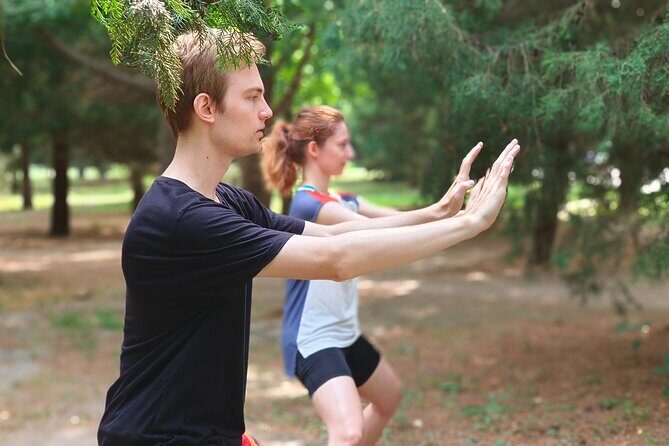
- Temple of Heaven area practice: You train outdoors where the atmosphere is part of the experience.
- Kung Fu master Liu’s English: Clear communication makes the movements easier to copy.
- Real skill sequence: Stances and basics first, then the five-stance fist form.
- Joint-locking and self-defense: Practical techniques are taught as controlled training, not wild fighting.
- 90 minutes is the sweet spot: Long enough to learn a form and fundamentals, not so long you’re exhausted.
- Private group feel: Only your group participates, which helps the class stay attentive.
A Park-Setting Kung Fu Class Near the Temple of Heaven
You don’t come to this class just for movie-style kicks. You come to learn what traditional 功夫 (kung fu) means in everyday training: posture, control, and body mechanics, plus the idea that practice shapes discipline and awareness.
What surprised me was how comfortable the setting felt. The class takes place around the Temple of Heaven area, and the practice often happens with shade from trees. That matters. In Beijing, the weather can swing. Having the instruction outdoors but not in full sun makes a big difference to how well you can focus on form and footwork.
Also, there’s a sense of place here. Even if you’re not a martial arts person, you’re training in an area that fits the cultural idea behind kung fu: movement that’s both physical and aesthetic, not just impact.
You can also read our reviews of more tours and experiences in Beijing


Meeting Point at 旻园1 Tian Tan Dong Lu: Simple, But Plan Ahead
The class starts at a specific meeting location: 旻园1 Tian Tan Dong Lu, Dong Cheng Qu, Bei Jing Shi, China, 100061. It ends back at the same meeting point, so you’re not trying to track an unknown drop-off.
Because there’s no hotel pickup, I’d treat this like a targeted, appointment-style activity. You’ll want to confirm your route from where you’re staying and give yourself enough buffer time. The plus side: it’s near public transportation, so you can get there without needing a private car.
If you’re used to tours that pick you up and handle the handoff, this one is more hands-on on your end. The good news is that the instructor is there and ready to start on time. In real terms, that means fewer awkward minutes hunting for your group once you arrive.
What You Learn: Stances, Punches, Kicks, and the Five Stance Fist
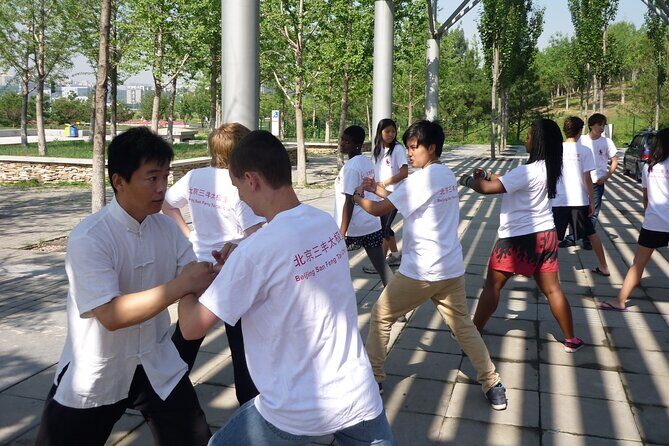
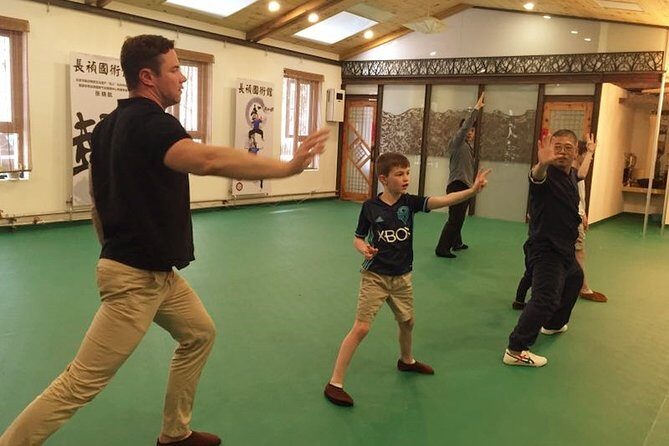
The training follows a clear progression. You start with foundational Kung Fu gestures and simple form work. Then you build into movements you can actually understand and repeat.
Here’s the core learning flow:
- Basic kung fu training: stances, kicks, punches
- Kung Fu five stance fist form
- Joint-locking techniques
- Self-defend techniques
The first stage is the most important, and I liked that the class didn’t rush past it. Learning stances and basic strikes gives you something to anchor on. Without that, the five-stance form can feel like choreography instead of skill.
The five-stance fist form is a big deal in a class like this because it’s not just one move. It’s multiple positions and transitions connected as a sequence. When you understand the sequence, you stop guessing and start feeling the pattern. That’s when the practice clicks.
For English-speaking students, a huge factor is how the instructor explains what you’re doing. The instructor in this class, master Liu, is reported to teach with great English. That matters for safety too, because you can follow directions without playing interpretive dance with body language.
Joint-Locking and Self-Defense: Controlled, Not Chaotic
Later in the session, you move into joint-locking and self-defense. This is where a lot of beginner classes either get too vague or too intense. What I like about this format is that it’s presented as training techniques you can practice with control.
Joint-locking techniques are about leverage and position, not brute strength. Even in a short class, you can learn the basic idea: where your body should be, how your balance matters, and how to apply technique with awareness.
For self-defense, the goal isn’t turning you into an action hero in 90 minutes. It’s learning some fundamental responses and mechanics so you understand how defense can work without panicking. You’re taught as part of a group, which helps keep energy realistic and focused.
If you have kids in your group, this part can be especially valuable because it teaches discipline and restraint. It’s movement training with boundaries, not a free-for-all.
Why “Basics” Is the Real Value in 90 Minutes
It’s tempting to judge a kung fu class by how high the kicks are or how fast the strikes look. In a short experience like this, that would be the wrong metric. The real value is whether you leave with fundamentals you can replay later.
This class aims to give you exactly that: basics that map to the five-stance form and practical technique concepts. If you walk out remembering how to stand, how to move your weight, and the sequence of the five-stance fist form, you’ve gotten your money’s worth.
There’s also a cultural angle baked in. For Chinese practitioners, kung fu is tied to moral cultivation, body building, and aesthetic appreciation. You may not memorize every concept during a single session, but you can feel the approach: control, posture, and precision. That’s a refreshing change from purely performance-based training.
And yes, pop culture helps. People often arrive thinking of Bruce Lee, Jet Li, or Jackie Chan. But this class reframes kung fu as something more grounded than movie fights. You practice what the foundation would be before anything flashy.


Group Feel, Pace, and Keeping Everyone Interested
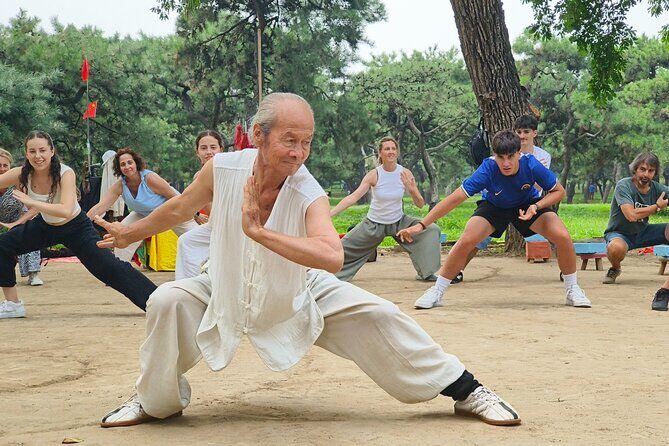
Even though it’s a class, it’s set up as a private activity for your group only. That tends to improve the quality of attention you receive, especially if you’re traveling with family.
From what I’ve seen in similar classes, the hardest part is maintaining interest across ages and fitness levels. Here, the instruction is designed for people who can manage moderate physical movement, and it generally works well for mixed groups.
The class also has a way of keeping the session lively. One helpful detail: the training is sometimes paired with a bit of music in the park. That can make repeating movements feel less like drill time and more like guided practice.
If you’re traveling with kids, bring patience and a sense of humor. The goal for younger students isn’t perfect technique on day one. It’s staying engaged long enough to learn the basic stance-and-sequence idea.
Price and Value: Is $65 a Good Deal?
At $65 per person for about 1 hour 30 minutes, this experience lands in the mid-range for hands-on cultural activities in Beijing. The question is what you’re buying besides entertainment.
You’re buying:
- instruction from a qualified kung fu master
- an entrance ticket (so you’re not hunting for add-on costs)
- a structured training sequence that includes stances, a five-stance fist form, plus joint-locking and self-defense
- a private group setup, which often means less time waiting and more time learning
What pushes the value up is that you get real teaching time, not just a quick photo op. You also get the advantage of practicing in an iconic area—the Temple of Heaven vicinity—where the setting matches the subject matter.
What could limit value for some people is this: if you want an all-day, deep apprenticeship-style program, 90 minutes will feel short. But if you want a satisfying first taste of kung fu fundamentals, this is priced like an efficient, focused lesson.
Also worth noting: it’s typically booked about 27 days in advance. That’s a signal the class is popular, especially for families. If your dates are fixed, don’t treat it as a last-minute option.
Practical Tips: How to Prepare for 90 Minutes
You don’t need martial arts gear for this class, but you should come ready to move comfortably.
Here’s what I recommend:
- wear comfortable clothes that let you bend, step, and extend your legs
- choose flat or grippy shoes (or comfortable sneakers)
- bring a light layer if the weather shifts in the park
- keep expectations realistic: you’re learning a sequence and fundamentals, not performing at championship speed
Because there’s a moderate physical fitness level requirement, pace yourself. If you’re new to exercise, the stances and footwork will do most of the work. Once you find your balance, the rest gets easier.
Since the class ends where it starts, plan to keep that time block clean. You’ll learn best when you’re not rushing to your next stop.
Should You Book This Beijing Kung Fu Class?
I’d book it if you want a hands-on cultural activity that’s more than sightseeing. This class hits a sweet spot: beginner-friendly fundamentals, a structured sequence, and practical technique concepts in a real training environment.
Book it especially if:
- you’re traveling with family and want something that can hold attention across ages
- you like learning physical skills with clear guidance (English support is a big plus)
- you want kung fu to be about posture and control, not just flashy moves
Skip it if:
- you want serious sparring or advanced training depth
- you’re relying on hotel pickup and don’t want to handle transport to the meeting point
If you do book, go in with one mindset: learn the basics well. In 90 minutes, that’s exactly what you can master—and it’s what you’ll remember later when you try the form again.
FAQ
Where does the class start and end?
The experience starts at 旻园1 Tian Tan Dong Lu, Dong Cheng Qu, Bei Jing Shi, China, 100061 and ends back at the same meeting point.
How long is the Chinese Kung Fu experience class?
It runs for about 1 hour 30 minutes (approximately).
What is included in the ticket price?
The experience includes a high qualified kung fu master and an entrance ticket.
What’s not included?
Hotel pickup and drop off are not included.
Is this a private group activity?
Yes. This is a private tour/activity where only your group participates.
Do kids need to be accompanied by an adult?
Yes. Children must be accompanied by an adult.
What fitness level should I have?
The activity requires moderate physical fitness.
Do they use a mobile ticket?
Yes. The class includes mobile ticket delivery.
Can I cancel and get a full refund?
Yes. You can cancel for a full refund up to 24 hours before the experience’s start time.