REVIEW · BEIJING
Beijing Private Religious Tour: White Cloud Temple, Lama Temple, Niujie Mosque
Book on Viator →Operated by Catherine Lu Tours · Bookable on Viator
Beijing’s temples tell one story at three angles. This private 8-hour circuit connects Buddhism, Daoism, and Islam in one day, with hotel pickup, a private driver, and an English-speaking guide who helps the monuments make sense. I especially love the pre-paid entry setup, so you’re not stuck at ticket windows, and I like that lunch is included so the day doesn’t turn into a scramble. The main drawback to consider is time: it’s an intense schedule with about an hour at each stop, and there’s an extra fee if you go beyond 8 hours.
The payoff is how the guide stitches together the ideas behind the buildings. You’re not just checking boxes—you’re learning how different faiths have shaped daily life, art, and even power structures across China. It’s also flexible enough to adjust for weather or your interests, which matters in Beijing.
In This Review
- Key highlights I’d center in your planning
- Why this private religion circuit works in Beijing
- Morning logistics: hotel pickup, pre-paid entry, and fewer time-wasters
- Lama Temple (Yonghegong): the first stop and why it sets the tone
- Confucius Temple and Guozijian Museum: where scholars were trained
- White Cloud Temple and Baiyunguan: Daoism and the Quanzhen thread
- Niujie Mosque: Islam’s long Beijing presence
- Lunch in the middle: why included food matters on an 8-hour day
- Price and value: is $144 per person worth it?
- Who this private tour suits best
- Should you book it?
- FAQ
- What time does the tour start?
- How long is the tour?
- Are entrance tickets included?
- Is lunch included?
- Is this tour private?
- Do I need to tip the guide or driver?
- Is there a cancellation deadline for a full refund?
Key highlights I’d center in your planning
- Pre-paid tickets mean less waiting and more time inside
- Hotel pickup and drop-off with a private, air-conditioned car
- English-speaking guide who explains what you’re looking at (clear English noted by past guides like Peter and Stephen)
- Three religion stops, one route: Lama Temple, Confucius Temple + Guozijian, White Cloud + Baiyunguan, then Niujie Mosque
- Lunch included at a local restaurant so you can keep moving without stress
- Mobile ticket delivery for a simpler day
Why this private religion circuit works in Beijing
Beijing is packed with big-name sights, but religion sites are different. They don’t just look old. They’re still active spaces with real rituals, prayers, and meaning tied to the neighborhoods around them. When you try to do these alone, you often end up reading a few signs and guessing the rest.
This tour is designed to prevent that. You get a private driver so you’re not bouncing between buses and multiple drop-offs. You also get an English-speaking guide who can explain what you’re seeing as you go—so the statues, halls, and sacred objects become understandable, not just photogenic.
I also like that you move through different faith traditions in one day. Buddhism, Daoism, and Islam each have their own visual language—incense culture and temple layouts on one end, scholarly Confucian worship next, and then the mosque’s distinct design and community focus. A single route makes those contrasts clearer than a stop-by-stop self-guided approach.
One practical note: this is still a full day. Even though each major stop is about an hour, you’ll spend time driving between them. If you want a slow, lingering museum-style day, you might feel rushed at the temples. But if you want a smart hit of the highlights with context, this format fits well.
You can also read our reviews of more private tours in Beijing
Morning logistics: hotel pickup, pre-paid entry, and fewer time-wasters
Your day starts at 8:30 am, with hotel pickup at the lobby around the planned morning time. Then you head out by private, air-conditioned vehicle with gas, tolls, and parking handled. This matters more than it sounds. In Beijing, getting from one walled complex to another can eat time fast—especially if you’re trying to coordinate transport yourself.
One of the biggest quality-of-life wins here is the pre-paid entrance tickets. Instead of lining up at the ticket booth right when you arrive, fees are handled in advance by the tour operator. You also get mobile tickets, which helps keep your day simple. Less paperwork. Less standing. More time looking closely.
The tour runs about 8 hours. If you add time past that, there’s an extra fee. That’s worth keeping in mind if you’re the type who wants to take “just one more look” for a long stretch. For most people, the standard time is enough to see the main highlights without burning out.
Also, the plan is described as flexible. If weather changes or your priorities shift, the route can be adjusted to match your interests. That flexibility is a big deal in Beijing, where conditions can shift quickly.
Lama Temple (Yonghegong): the first stop and why it sets the tone
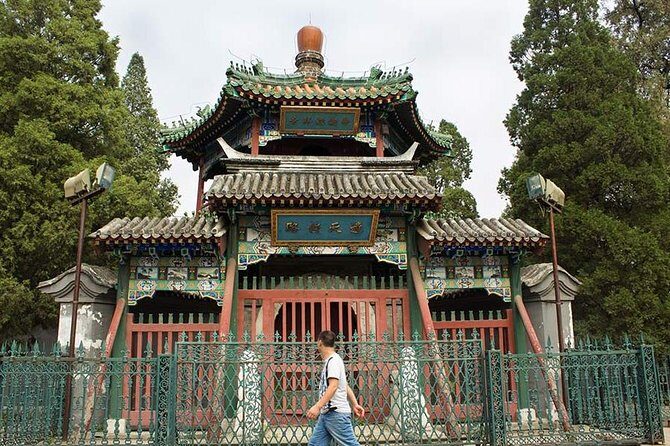
You start with Lama Temple (Yonghegong), and that choice makes sense. It’s one of Beijing’s most famous Buddhist temples, and it tends to “turn on” your attention for the rest of the day. Once you’ve seen the scale and the atmosphere here, the later sites start to feel more connected rather than random.
The experience at Lama Temple is about seeing how Buddhism expresses devotion through space. Expect a strong temple presence, with halls and religious objects arranged to guide you through a sequence of focus. Even if you don’t know the terms, a guide can point out what to watch for—what the symbols are doing, how the layout supports ritual, and why certain details matter.
You’ll get about 1 hour at this stop. That’s not enough for a deep, slow meditation session. But it is enough for you to walk the main areas, understand what you’re seeing, and get photos that aren’t just sightseeing shots.
A drawback to consider: because this stop is a top attraction, it can draw crowds at peak times. Pre-paid entry helps, but your time still depends on how quickly you can move through the spaces. If you’re sensitive to crowds, keep your expectations realistic for a high-demand temple.
Confucius Temple and Guozijian Museum: where scholars were trained
Next up is the Temple of Confucius and Guozijian Museum. This part of the route adds an important twist: it’s not just about one faith. It’s about Confucianism’s influence on China—especially the way imperial governance treated learning and moral order.
The Temple of Confucius is a place of worship, while Guozijian refers to the ancient educational complex that trained scholar-officials who ran imperial China. Seeing them together helps you understand that Confucianism wasn’t only philosophy for books. It was tied to institutions, examinations, and the social idea that rulers should be educated and ethically grounded.
In about 1 hour, you can typically do two things well: (1) look at the memorial and sacred areas with guidance, and (2) connect the museum content to the broader idea of how China organized education and power. A good guide helps you avoid the common trap of thinking Confucianism is just old-school study. It was also a system.
Practical tip for your mindset: don’t treat this stop like a museum-only diversion. Think of it as an explanation of how belief, ethics, and authority were intertwined in traditional China. That lens makes the later religious sites easier to interpret too.
White Cloud Temple and Baiyunguan: Daoism and the Quanzhen thread
After Confucius, you head to the White Cloud Temple area, including Baiyunguan Taoist Temple (often described as one of the major ancestral courts of the Quanzhen School of Daoism). This is where you shift from scholarly Confucian themes back into devotional and spiritual practice.
The White Cloud Temple stop is described as historically significant, including an origin date that reaches back to the mid-8th century. For many visitors, that’s one of the most surprising parts of Daoism on a first trip: these aren’t just modern spiritual sites. The architecture and traditions you see today are tied to long timelines.
What I like about having this stop in the same day as Lama Temple and the mosque is that you can compare styles and goals. Buddhist temples tend to emphasize the visual and ritual expression of worship and enlightenment. Daoist sites often connect to spiritual cultivation, lineage, and sacred space tied to schools of practice. Even if you don’t know the terms, your guide can translate what the site’s details are trying to communicate.
You get about 1 hour here as well. With that time, you’ll likely cover key sections and come away with a clearer sense of Daoism’s organizational structure rather than just admiring buildings. If you prefer architecture and symbolism, this is often the stop where your notes start to feel real.
A consideration: Daoist complexes can sometimes feel more diffuse than a single dominant hall, depending on how you walk through. That’s where a guide helps. They can point you toward the sections that matter most for your time.
Niujie Mosque: Islam’s long Beijing presence
The last major stop is Niujie Mosque, described as among the oldest and most important mosques in China, and as the largest mosque in Beijing. Ending here is smart because it changes the visual language again. You’re no longer dealing with temple worship layouts in the same way. A mosque experience is its own world, shaped by community use, worship design, and distinct architectural choices.
Niujie Mosque is also tied to the neighborhood history around it. Your guide can help you understand how Islam took root and developed in China over time—not just as an imported idea, but as a lived tradition with local presence.
Expect about 1 hour at this stop. That’s enough time to appreciate the scale and key features, and to understand the basics of what makes the site significant. It also gives you a strong closing contrast to earlier stops: in the morning you started with Buddhism, then moved through Confucian education and Daoist sacred space, and you end with Islam’s major Beijing landmark.
One practical note: with any active religious site, you should be respectful with photos and keep your behavior mindful. Even if the tour is focused on sightseeing, the site is still a functioning place of worship.
Lunch in the middle: why included food matters on an 8-hour day
One of the easiest reasons to like this tour is the complimentary Chinese lunch at a local restaurant. This is not just a perk. It directly affects your energy level and your pacing.
Without lunch included, you’re forced into one of two bad outcomes: either you stop somewhere random near the next site, or you risk losing time hunting for food. With lunch handled, you can keep a steady rhythm and finish the day without feeling frazzled.
I also like that the tour includes lunch in a planned way, because the day is otherwise packed into four main religious stops plus driving time. That means your hunger can become a distraction fast. Included lunch helps you stay focused on the actual purpose of the day: understanding what you’re seeing.
Price and value: is $144 per person worth it?
At $144 per person, this isn’t a budget “grab a ticket and go” situation. It’s priced like a private half-day that gets a lot done, and the value depends on what you compare it to.
Here’s what you’re paying for, in practical terms:
- Private, air-conditioned transport with pickup and drop-off
- An English-speaking guide for explanation and pacing
- Pre-paid admission tickets for each stop, so you don’t waste time at booths
- Lunch included at a local restaurant
- Gas, tolls, and parking handled
If you were to recreate this yourself, you’d likely pay separately for car service, guide time, and individual entrances. And you’d probably lose time negotiating logistics. The private nature is also a real value for religious sites: you can ask questions in context and adjust your pace as you go, instead of following a fixed bus-tour script.
One more cost consideration: the tour is about 8 hours, and an extra fee may be requested after 8 hours. If you want a late finish, factor that in early.
Overall, I see this as good value if you want context and fewer delays. If you just want photos and you’re comfortable figuring everything out on your own, then it might feel pricey.
Who this private tour suits best
This tour fits best if you’re the kind of traveler who:
- Wants one-day access to major religious sites without juggling transport
- Likes explanations, especially on how religious traditions link to culture and governance
- Enjoys comparing different faith design and worship styles
- Wants lunch included so you don’t burn time on meals
It may be less ideal if you want:
- A slow, deep study of each complex without time pressure
- An extremely flexible day that runs well beyond 8 hours
- A more off-the-beaten-path route where you trade time for lesser crowds
A final note on guide quality: English clarity matters here because so much of what makes these sites meaningful is not obvious at first glance. Past experiences with named guides like Peter and Stephen have been highlighted for clear explanations and, in Stephen’s case, a strong supply of Chinese fables and folklore that add flavor without hijacking the day. That kind of storytelling is exactly what turns stone and incense into something you can actually remember.
Should you book it?
I’d recommend booking this private tour if you want a structured, time-friendly way to understand Beijing through religion and philosophy, with minimal waiting and a guide who can explain what you see. The pre-paid tickets, hotel pickup, and included lunch remove a lot of the usual friction of temple-hopping.
Before you book, consider your tolerance for a packed day. You’ll see four major stops in roughly 8 hours, with about an hour per site. If you’re okay with that pace, you’ll likely leave with a clearer picture of how Buddhism, Daoism, Confucian influence, and Islam all shaped Beijing’s cultural identity.
If you want to slow down, you can still make it work—just don’t assume you’ll linger endlessly at every hall without trade-offs.
FAQ
What time does the tour start?
The tour starts at 8:30 am.
How long is the tour?
The duration is about 8 hours.
Are entrance tickets included?
Yes. Entrance tickets to the sights are included, and fees are handled in advance so you don’t wait at the ticket booth.
Is lunch included?
Yes. The tour includes a complimentary Chinese lunch at a local restaurant.
Is this tour private?
Yes. It’s a private tour/activity, so only your group participates.
Do I need to tip the guide or driver?
Tipping is not included, so gratuity to the guide and driver is up to you if you feel the service was good.
Is there a cancellation deadline for a full refund?
Yes. You can cancel up to 24 hours in advance for a full refund.